
The Sixth Sunday after Pentecost (July 1, 2018)
Church of the Ascension and Saint Agnes – Washington, D.C.
Lectionary readings:
2 Samuel 1:1, 17-27; Psalm 130; 2 Corinthians 8:7-15; Mark 5:21-43
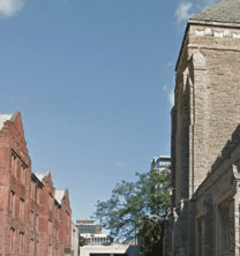
On Hoskin Avenue in Toronto, Ontario Canada two esteemed institutions of theological training face one another from opposing sides of the street: the red-bricked Wycliffe College in the Evangelical or low-church Anglican tradition and the stone-façaded Trinity College in the Anglo-Catholic tradition. Several years ago, a friend of mine visited both institutions during Eastertide, and upon arriving at Wycliffe discovered a large sign out front that proclaimed, “He is risen! He is not here!” She further discovered, however, that someone had taken a large marker and underneath scrawled, “He is across the street!”
While this was presumably a humorous slight done in jest, the honest reality is that we often find ourselves in truly pitched battles about the right ways and the wrongs ways to do things, and we quickly lose sight of the higher and deeper calling we have to transcend such divisions for the sake of the Gospel. Nowhere do we see this better than in today’s Gospel reading. The stories of Jairus and his daughter on the one hand, and of the hemorrhaging woman on the other display in sharp relief the reality that God’s work in the world transcends every single constraint or parameter that we might want to put on it. See, in this narrative we have two contrasting experiences that at once share a common conviction and commitment to Christ’s Kingship.
Jairus is a man of position, power, and influence. A leader of the Synagogue, it is clear throughout the story that he is risking a lot to come to Jesus. Towards the end of the narrative, we see that his contemporaries and friends, likely even his own family, scorn and ridicule Jesus upon arrival. The clear indication here is that he is a man who “should know better.” His kind of people do not need help, do not need healing, do not need a savior. None of that fazes Jairus, however. In the tragedy of his daughter’s illness, Jairus sees his own brokenness, and he is humbled in his helplessness. His conviction that Christ is truly powerful, his confidence in the Saviour’s ability to heal the sick, compels him beyond the scorn and ridicule to the very feet of Jesus. The mighty brought low in humility and powerlessness.
And then we have this unnamed woman who has suffered from twelve years of hemorrhaging. This is an almost unbelievable level of suffering. Her attempts to seek healing and wholeness have left her destitute and broken. According to the Jewish law of the time, her affliction legally puts her in a state of constant ritual impurity and exiles her to the very marginal fringe of society. Her kind of people, the other hand, people not even worthy enough to be named, seem beyond help, beyond healing, beyond salvation. How dare she dare approach one such as Jesus? Yet, her audacity, her desperation, compels her forward towards an action done in secret, illicit and illegal. And in that moment the world seems to stop for the briefest of seconds. Jesus, feeling the power go forth, immediately interrupts his forward movement towards Jairus’s house and daughter, forward movement towards the ostensibly more important people in this story, to identify and address this woman. In that moment it is as if she realizes the seriousness of her cultural violation. In fear and trembling it says, she too comes and falls at the feet of Jesus and bears her life to Him. And what does Jesus do in response? With no rebuke, no malice, with nothing but pure love Jesus proclaims her faithfulness, names her as a daughter of God, and pronounces a blessing upon her as he sends her forth. The lowly raised up and glorified in the Lord.
Any pretense here that purity, status, gender, or any other category of separation somehow matters is completely rejected by Christ. In our Gospel passage today, He simultaneously names and acknowledges the faithfulness and sincerity of both the unnamed woman and Jarius, the low in this story and the high, the poor and the rich. Christ transcends all of the seeming constraints in this narrative in order to respond to pleas for his mercy and healing touch. In this way we discover a similarity between the unnamed woman and Jairus. Both share an earnestness to seek out Christ’s intercession, confident in his power, affirming of His Kingship. They both disregard social expectations and pursue risky courses of action. Jairus’s humility shares the spotlight with the woman’s audacity. Humility to recognize our own powerlessness and the audacity to ask the creator and redeemer of the universe for what we need.
This dual pairing of humility and audacity has another added layer as well. This passage from Mark Chapter 5 is sandwiched between two other narratives of groups who stand in contrast to faithfulness displayed in today’s reading. Last week, we heard the story from Mark Chapter 4 of the disciples crying out in terror and fear while in a boat cast upon stormy seas. By this point in Mark, Jesus has driven out the evil spirit from the man in Capernaum, healed Peter’s mother-in-law, cleansed a man of leprosy, healed the paralytic lowered from the rooftop, and healed the man with the withered hand, among other numerous acts of healing and mercy… and yet these thick headed disciples still lack faith in the trial of bad weather, even though Jesus remains among them! Next week, in Mark Chapter 6, we will encounter Jesus returning to his hometown confronted with yet more faithlessness. Confronted by people who have known him his entire life, these equally thick headed folk seem unable to see that which is right in front of them because they are so caught up in the convictions and beliefs that they hold about how the world works. They are unable to look beyond their own assumptions to witness the truth that God is manifesting before their very eyes.
So what are we to do with all of this? What does audacity and humility look like for us today as encounter the faithfulness of the unnamed woman and Jairus? For this, we can look to our passage in Second Corinthians. While the passage goes on to talk about generous giving, look first at how Paul opens this particular passage, “Now as you excel in everything – in faith, in speech, in knowledge in utmost eagerness…” The community at Corinth is already in the midst of striving towards the Kingdom. They are already working on getting their priorities straight in practicing Christ-centered faith, Christ-centered speech, Christ-centered knowledge, and Christ-centered eagerness. Yes, generous giving is of vital importance, but it is vitally important in the midst of a community already living in a Kingdom-centered way. You see, the community at Corinth was not so different from our own context here. The Corinthians were living as a blended community, both Gentile and Jew, and they were striving to live Christ-centeredly, Kingdom-centeredly in the midst of that reality. Like our Gospel passage, these were folks who had likely come to the table with rather rigid ideas about how the world works, and in encountering the savior they became radically transformed into a more welcoming, loving, generous community. Especially in this city, especially at this time in our nation’s history, it is clear that we are struggling with this same issue. Republican, Democrat, liberal, conservative, all those folks somewhere else on the spectrum. We are mired in our own divisions without a seemingly clear path forward. And yet this morning, the answer stairs us right in the face. All of these designators all of these somehow become less important, less significant when we fall at the feet of Jesus and ask to be transformed.
And what does that community look like? It looks like a community of generosity, a community of wholeness, a community of Love. It is a community that incorporates the rich and influential insider and the marginalized and oppressed outsider simultaneously and seamlessly. Imagine what the Church would like today, if we recommitted ourselves in earnest desperation to the heart of the Gospel, if we put aside how divisions to welcome everyone in love in the name of Christ. If the prayer on our lips every moment of every day was, “Thy will be done Lord on Earth as it is in Heaven.” Imagine the witness that this would have in the world, in our nation, in our very city. Imagine the president and a refugee woman falling together at the feet of Jesus begging to be transformed and made whole. This is kind of power that we are taking about here, and this is the kind of power that we the church witnesses too when we most fully to the Gospel mission to which we are called.
You know at the end of the day, the sign at the beginning of the sermon was not completely wrong. Yes, Jesus is Risen and not in the tomb, and yes Jesus is here with us now as we gather in worship and praise, but Jesus in case we forget is also across the street. Jesus is out there as much as he is in here. When we live into our mission to be a Christ-centered, Kingdom-centered faithful community filled with generosity and live, we will play our part in bearing witness to the truly earth shattering and transformative reality that is a life in Christ into an broken and hurting world seeking that peace which passes understanding. So, let us be reinvigorated in our faith, renewed in our hopes, and reoriented towards the work that truly matters. Amen.
 Ad Orientem