
The Feast of Saint Luke (October 18, 2016)
Virginia Theological Seminary
Lectionary Readings:
Ecclesiasticus. 38:1‐4, 6‐10, 12‐14; Psalm. 147; 2Timothy 4:5‐13; Luke 4:14‐21
Beginnings and Endings. That is what today’s scripture readings capture in many ways. On the one hand, in the Gospel reading we have Jesus in the Synagogue in Nazareth, beginning his ministry after returning from the Judean Desert. On the other hand, in our Epistle reading from Timothy, we have Paul ending his ministry. “As for me, I am already being poured out as a libation, and the time of my departure has come. I have fought the good fight, I have finished the race, I have kept the faith.” Beginnings and Endings.
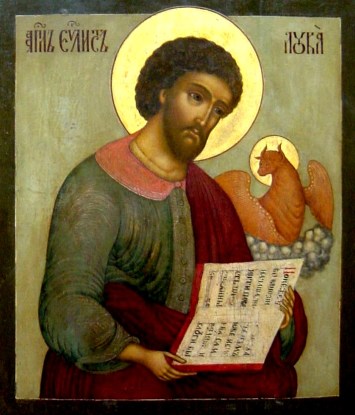
I have to admit, I have really struggled to put this sermon together. As we celebrate the feast of Saint Luke today, we customarily celebrate him not only as the Evangelist but also as the Physician. Healing and Good news… I am sadly left wondering where either are in our present circumstance. Where is the healing? Where is the good news? It seems that no matter where we turn, all we are confronted with is conflict, violence, suffering, and despair. This feels like an Ending, but not one to be proud of. Just yesterday, a supporter of Donald Trump was interviewed on CNN and claimed that were Hillary Clinton to be elected, she would herald the End Times, while the day before Salon ran an article titled, “Donald Trump the arsonist: The GOP nominee is inching America toward the apocalypse.” And this is just here in the United States. When we consider the ongoing humanitarian crisis in Syria, the continuing violence in South Sudan, the deepening ecological crisis everywhere else. What do we do? Where is our good news? Our healing balm in Jesus Christ?
The Swedish Lutheran bishop and scholar, Yngve Brilioth identified in our Lukan passage what he argued are the three fundamental motifs or characteristics of Christian preaching. There is the liturgical aspect, the exegetical aspect, and the prophetic aspect. Preaching occurs within the gathered assembly, in the context of worship; it offers an exegesis and reflection on scripture; and it speaks prophetically into the present moment offering a glimpse of a world as it can be in God. Reframing Brilioth a bit, I think his three motifs offer us a way forward today. A new beginning in the midst of so many endings. An opportunity to find healing and good news in a time and place so broken and so disordered.
First, we come together as a community in the context of the worshiping act. This experience of liturgy should not be taken for granted. If you are not a senior or an Anglican studies student yet, you still have Dr. Farwell’s introductory lecture on the liturgy to look forward to. As I was reminded when he visited my field education parish this past Sunday, to talk about liturgy as the work of the people is a misnomer. A Liturgia was a benevolent act done by a benefactor for the good of the people. As Christian theology and reflection developed over the centuries, we came to understand the liturgy to fundamentally be Jesus Christ – the act, the work done, in and by God for the benefit of all humanity. Thus, our participation in the liturgy, is a participation in the work and life of Christ. A joining in unison with him as he redeems the world. The fundamental act of our coming together, is by its nature a new beginning in the midst of so many endings. In as much as we are unified in Christ through worship, we are agents of the coming kingdom in the world. Our experience here should lead us to transform the world out there.
Second, we can ask what our scripture says to us today, how it transforms and enlightens us so as to do a new work in the world. Admittedly, I was struck by what seems a rather limited pericope in our Gospel passage today. Essentially, we have Jesus entering the Synagogue in Nazareth, reading the scriptural passage from Isiah, and exegeting by proclaiming, “Today, this scripture has been fulfilled in your hearing.” We get no further context. If we broaden our view a bit, we see that Jesus had been baptized by John in the Jordan and was just now returning to Galilee from forty days of fasting and temptation in the Judean desert. An ending and new beginning. This new beginning is not without struggle, however. For we see, immediately following Jesus’s teaching, the sideways glances and skeptical questioning. “Is not this Joseph’s son?” New beginnings are not always easy nor free from their own forms of pain and suffering. As Paul admonishes Timothy, “As for you, always be sober, endure suffering, do the work of an evangelist, carry out your ministry fully.” Our joining with Christ in his redeeming work in the world, is not easy and not painless, but it is righteous and it is fulfilling. It is our new beginning in the midst of so many endings.
Finally, what is the prophetic word today which breaks into the present moment offering us a glimpse of a world as it can be in God? As Gordon Lathrop observes about the fourth chapter of Luke in its totality he says, “Jesus was welcome as ‘one of ours’ but not as the breaker of the strong boundaries of the meeting. It is as if, had anyone listened to Jesus, they would have asked how they might follow the sermon by sharing in Zarephath’s meal or Naaman’s bath, thereby joining those outsiders whose only hope is in God.” We only experience the new beginning, we only embrace the healing and good news of Jesus, to the extent that we are drawn out of this place and into the world. There are so many endings right now. So much pain and suffering, but the new beginning that we hope for in Christ will only be realized through our consent and participation in the work we do in Him. It is for us to leave this place and transform the world with new beginnings. This is our sending out. This is our healing balm for the world. This is our Evangelism.
Amen.
 Ad Orientem